It
is no secret that Icelandic nature, which is still
in the process of being formed, is massively beautifully
- and unique. Forces of nature are in constant
conflict: water and land, fire and ice. In addition,
Iceland’s history and culture are extremely
interesting, and no other
place in the country provides a better window into
the soul of the nation than Thingvellir National Park.
Hengill
Just 30 minutes from Reykjavík is an incredibly
interesting area from a geologic viewpoint. It is
the Hengill high-temperature zone. Small earthquakes
and tremors are common in the area, which has warm
pools, hot springs and bubbling mud pools, and a maximum
elevation of about 2700 feet above sea level. The
mountains are unusually shaped, something like sculptures
after thousands of years of weathering. There are
hiking trails throughout the Hengill area, making
it relatively easy to walk in this magical place.
Under the surface of Hengill are enormous reserves
of geothermal water that have many uses, for example
for space heating and electricity production. Because
of its proximity to Reykjavík, the area is
ideal for outdoor activities, and for experiencing
the magic of Icelandic nature.
Nesjavellir
Most foreign heads of state that visit Iceland, as
well as other visiting dignitaries, ask to see Nesjavellir
Power Plant. The station, operational since 1990,
is an excellent example of how man has succeeded in
harnessing nature’s energy. Thermal water is
pumped up from 22 wells that are from 1,000 to 2,000
yards deep. The water temperature is as hot as 380°C
(684°F). The area produces 90Mwe of electricity
and 1,100 l/s of 88°C (158°F) hot water, which
is equivalent to 200 Mwt of geothermal power. This
power is completely environmentally friendly. When
the energy has been drawn from the thermal water,
it is pumped back into the ground.
Thingvellir
Everyone visiting Iceland must travel to Thingvellir
National Park, a holy site in the eyes of Icelanders
because of its historical significance, and striking
beauty. Thingvellir is considered to have a unique
value for the global community, and as such was recently
designated a UNESCO World Heritage Site.
The park is located only a few minutes drive/walk
from Nesjavellir. Considered a true jewel of Icelandic
nature, the area has a unique geological and geographical
setting. Iceland is situated on divergent tectonic
plate boundaries - the Eurasian plate in the
north and the North American plate in the west. As
a result, the country is slowly splitting apart -
as much as 2 cm per year, while the middle of the
country is slowly sinking. This process can easily
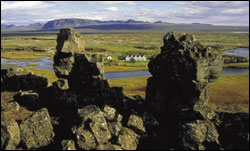
been traced to Thingvellir where a huge rift valley
is slowly forming, and is thought that the area has
sunk as much as 28 - 40 meters (90-130 feet)
over the past 10,000 years.
Thingvallavatn Lake is situated in the northern part
of the area, covering an area of 83.7 km² (32
sq.miles). The lake, which is the largest in Iceland,
is 114 m deep. Although three main rivers run into
the lake, 90% of the water entering it has traveled
from the distant highlands through thousands of underground
fissures. Not only is the area a beautiful and spectacular
natural wonderland, but it has as well an exciting
history. In the northern end of the lake is the site
of the oldest parliament in the world, which dates
back to 930 AD. Then, a constitutional law code was
accepted and the Althingi (Parliament) established.
The lake and the surrounding area provide for a wide
range of outdoor activities, such as fishing, sailing,
diving or a hiking. For more information about Thingvellir,
visit www.thingvellir.is
The Cradle of Democracy
It can be said that Thingvellir is the world’s
cradle of democracy. Thingvellir has long been a subject
for Icelandic artists, particularly painters such
as Jóhannes Kjarval and Ásgrímur
Jónsson, and Nobel Laureate Halldór
Laxness, a novelist that everyone visiting Iceland
should read. One recommended book is Íslandsklukkan.
All in One Place
Hengill and Thingvellir offer an incredible variety
of possibilities to experience history and nature.
It is easy to travel in the areas, and there are excellent
opportunities to hike and climb pristine mountains.
The areas are also great for photographers, amateur
as well as professional, and artists, as well as those
with a special interest in geology and history. Mainly,
though, they are areas that are awesomely beautiful,
and peaceful.
There is a cozy and comfortable hotel at Nesjavellir
offering friendly service, a good choice for anyone
interested in exploring the Thingvellir area.
For more information, visit
www.nesbud.is.




