Be a Leader…
 True North North Iceland offers a huge spectrum of scenery to explore, from the soft and gentle to the awesomely spectacular.
Akureyri, 45 minutes by air or a five-hour drive from Reykjavik, is a natural base for travelers with a whole world of nature right on its doorstep. Akureyri makes an ideal choice for winter breaks, with some of the finest ski slopes in Iceland as well as opportunities for snowmobiling, horse rentals, ice fishing and more.
An hour away by car is Lake Myvatn, where a sizable community has developed around this birdwatchers’ paradise. Bizarre natural lava sculptures stand out in and around the lake, while at geothermal fields the land is painted in all colors of the rainbow. Off to the east, Jokulsargljufur National Park completes the north’s triangle of “musts” including Dettifoss, Europe’s most powerful waterfall.
On Skjalfandi Bay, the town of Husavik has established itself as Europe’s main whale watching center, with astonishingly high sighting rates.
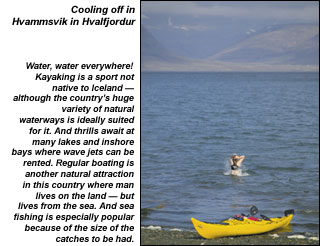 Skagafjordur district, with its smooth green valleys and mighty mountains, is the traditional heart of horse riding in Iceland and boasts some beautiful old buildings at its many historical sites. A wide range of travel services can be found at Saudarkrokur, the main town in Skagafjordur.
Exploring in the East
East Iceland accounts for a large chunk of Iceland’s total area and much of it is either farmland or wild, gradually merging into the great wilderness of the Central Highlands. Seydisfjordur is renowned for its impressive old houses from around a century ago, when it was one of the largest population centers in the country.
The regional center of the east, Egilsstadir, is deep inland, on the banks of the sprawling river Lagarfljot where cruises are offered. Nearby Hallormsstadaskogur is an impressive forest in a country otherwise almost bare of trees. Beyond that lies the wild and wooly natural habitat of Iceland’s reindeer population.
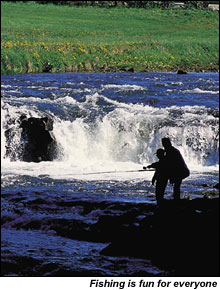 The port of Hofn on the southeast corner is the main base for exciting trips to the nearby glacial cap of Vatnajokull. Whale watching cruises operate from there too. Another top attraction in the southeast is on the glacier’s rim: Jokulsarlon glacial lagoon, renowned for its boat cruises among calving icebergs.
Few places in Iceland can match the wealth of contrasts found at Skaftafell National Park, where green woodlands and black mountains converge with the sheer white glacier in the shadow of the country’s highest peak, Hvannadalshnukur (6,950 ft.).
Highland challenges
Between north, south, east and west Iceland lies the “fifth dimension,” the great interior of the Central Highlands where man has never made his home and is still a rare visitor. Here, nature is still at its rawest, with glaciers, deserts of black sand, barren glacial moraine, steaming hot springs, active and spent volcanoes and strange oases of vegetation.
Two main overland routes link north and south. The western route over Kjolur is passable by ordinary vehicles in summer, skirting Langjokull glacier on the way to Hveravellir geothermal field before emerging by the Ring Road in the north.
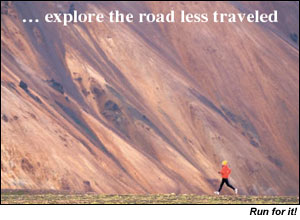 The other, more directly central route is over the black sands of Sprengisandur, and with only rough tracks as well as unbridged rivers it can only be negotiated by big 4WD vehicles, and even then preferably in convoy. The Sprengisandur route threads its way between glaciers to come out southeast of Akureyri, near Lake Myvatn.
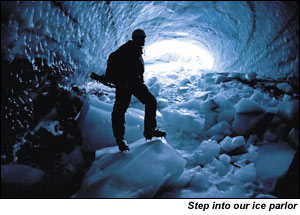
Other highland favorites are the area around Mt. Askja, where travelers can bathe in a naturally warm lake called Viti (Hell), and Kverkfjoll high-temperature geothermal field on the rim of Vatnajokull, where the heat creates fantastic but ever changing caves in the ice.