Sightseeing Spectaculars Mother Nature's
Special Effects Department
 Rugged
and moss-grown lava fields, some only a few centuries old,
greet visitors arriving at Keflavik Airport and spread right
across the southwestern Reykjanes peninsula. Geothermal activity
is also very much in evidence, in natural hot springs such
as Krysuvik and especially at the Blue Lagoon, a bathing spot
in the lava field by a geothermal power station, with mineral-rich
waters renowned for their health-giving properties. Coupled
with its interesting shores, birdlife and whale watching opportunities,
southwest Iceland makes an ideal place for a day tour from
Reykjavik or on a stopover, for visitors who don't have time
to explore the region in depth.
Rugged
and moss-grown lava fields, some only a few centuries old,
greet visitors arriving at Keflavik Airport and spread right
across the southwestern Reykjanes peninsula. Geothermal activity
is also very much in evidence, in natural hot springs such
as Krysuvik and especially at the Blue Lagoon, a bathing spot
in the lava field by a geothermal power station, with mineral-rich
waters renowned for their health-giving properties. Coupled
with its interesting shores, birdlife and whale watching opportunities,
southwest Iceland makes an ideal place for a day tour from
Reykjavik or on a stopover, for visitors who don't have time
to explore the region in depth.
South Iceland offers a variety of day tours from the capital
too, and its "Golden Circle" is a real must for sightseers.
Its centerpiece is Thingvellir, where early settlers established
an assembly in 930 AD which has evolved into the world's oldest
national parliament today. Besides its key historical role
through the centuries, Thingvellir is also a masterpiece of
nature, with a scenic lake and rifts which mark where the
continental plates of America and Eurasia meet and are spreading
apart.
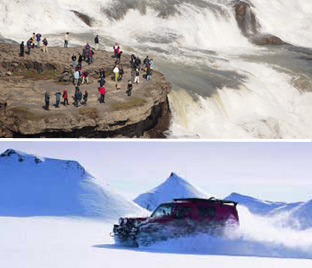
Other Golden Circle highlights include Gullfoss, the "Golden
Falls", a mighty two-tier waterfall in a chasm on the river
Hvita, and the geothermal fields of Geysir, where the spouting
spring Strokkur erupts boiling water and steam every five
minutes or so - as it happens, the "old faithful" Geysir itself
has suddenly begun spouting again after snoozing for decades.
The forces of nature in south Iceland have shaped not only
the land but man's life too. In medieval times people thought
fiery Mt. Hekla was the gateway to Hell. Off the south coast,
the Westmann Islands were evacuated for a couple of months
in 1973 because of volcanic activity - but the inhabitants
soon went back. Killer whale Keiko also left stardom in the
"Free Willy" movies to go back there to his native haunts.
Just off the Westmann Islands is Surtsey, a new island which
suddenly
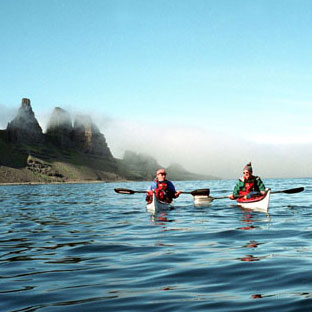
appeared out of the sea; access is limited to scientists,
however.
History is everywhere in south Iceland, too, spanning the
whole range from the Saga Age farm at Stong to the old bishop's
seat of Skalholt and the regional folk museum at Skogar, probably
the most comprehensive of its kind in the country.
Raw nature within easy reach
For a taste of the interior without "going the whole way,"
two gems of nature on the southern rim of the highlands are
among Iceland's most popular summer outdoor spots. Thorsmork
is a designated nature reserve, a hikers' paradise with woods
and grass nestling among mountains and glaciers and cut off
by powerful glacial rivers. It is divided into three separate
areas, one of which can be reached by road but the other two
only by driving through the river in very large vehicles at
specific places. Newcomers should not attempt the crossing
on their own - the river is unpredictable.
Landmannalaugar is a hotbed of geothermal activity, famed
for its springs where travelers bathe, and for the riotous
colors of its landscape and mountains - including shrieking
pink rhyolite. Landmannalaugar can be reached by ordinary
automobile, but you should drive carefully along the quite
bumpy road. Regular coaches operate to both �orsmork and Landmannalaugar
in the summer, and visits are included in some packages as
well.
Another treasure bordering the south Iceland interior is
the Lakagigar crater series inland from Kirkjubaejarklaustur,
which produced the largest lava flow ever witnessed in historical
times anywhere in the world, during the Skaftar eruptions
of 1783.

The Wild West
West Iceland, easily reachable from Reykjavik through a 4
mile tunnel under Hvalfjordur fjord, is a showcase of lava
formations, geothermal activity and history. Woodlands are
relatively common, and there are fine lakes and rivers for
fishing, as well as grand scenery with chasms and waterfalls,
overlooked by Langjokull and other glaciers on the rim of
the highlands.
On Snaefellsnes peninsula, amazing works of nature adorn
the entire landscape, culminating in the glittering glacial
cap of Snaefellsjokull, atop a crater which provided Jules
Verne with the setting for his classic Journey to the Center
of the Earth. The shore abounds in bizarre rock formations
and bird life, and a number of towns snuggle in bays on its
north coast, including Olafsvik where whale watching cruises
can be taken. From the largest town, Stykkisholmur, travelers
can take cruises or a ferry across Breidafjordur Bay with
its "countless islands." The ferry calls at Flatey Island
with period-piece houses that testify to its old status as
a major cultural center, although now only a handful of people
live there in the summer.
The West Fjords are the most sparsely populated region of
Iceland apart from the uninhabited highlands, typified by
sheer mountains rising from the sea and deep fjords with occasional
fishing villages snuggling against the slender seaboard. Isafjordur
is the main town, the regional center for services, scene
of plenty of social and cultural activities and starting-point
for many tours.
In the West Fjords, land meets sea in the most dramatic terms
imaginable, for example at the 1,312-foot sheer cliff of Latrabjarg,
the westernmost point of Europe and one of the biggest seabird
colonies in the world. Yet the region springs its surprises
too - Hornstrandir nature reserve, the northernmost point
of the West Fjords, is not only breathtaking in its rawness
but also astonishingly rich in vegetation on the rim of the
inhabitable world.



